New Life, New Lifestyle (Part 2 of 2)
Ministries > Truth For Life with Alistair Begg
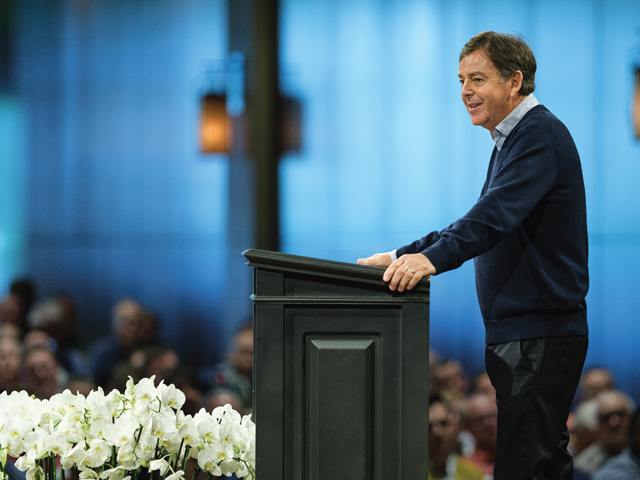
 Is God’s truth effective in a culture that’s blurred the line between right and wrong and shifted away from absolute truth? Listen to Truth For Life as Alistair Begg explains how God can use the world’s sense of confusion for the benefit of His purposes.
-----------------------------------------
• Click here and look for "FROM THE SERMON" to stream or read the full message.
• This program is part of the series ‘The Stranger’s Hope’
• Learn more about our current resource, request your copy with a donation of any amount.
Helpful Resources
- Learn about God's salvation plan
- Read our most recent articles
- Subscribe to our daily devotional
Follow Us
YouTube | Instagram | Facebook | X
This listener-funded program features the clear, relevant Bible teaching of Alistair Begg. Today’s program and nearly 3,000 messages can be streamed and shared for free at tfl.org thanks to the generous giving from monthly donors called Truthpartners. Learn more about this Gospel-sharing team or become one today. Thanks for listening to Truth For Life!
Bob Lapine: We live in a world where the lines between right and wrong have become blurred, and we have shifted from any sense of absolute truth to whatever works for you is fine. Today on Truth For Life, Alistair Begg points out how the world's sense of hopelessness and confusion can actually be used to benefit God's purposes. We're studying in 1 Peter chapter 1.
Alistair Begg: Holiness is a big subject, isn't it? Most of the time when we think about holiness, we think immediately of separation, which of course is accurate. we think often about clothing, especially when we think immediately about conduct, and he is addressing conduct, holy in all your conduct. So it's going to be expressed in a lifestyle. But again, my Scottish Presbyterian upbringing is, holiness is kind of scary. And I say that because my parents would have ministers to our home for Sunday lunch, and usually they left me on the couch by myself with one of these men. And they would say things to me like, “Ay, son, maybe one day you’ll be a minister.” And I say, I go through to my mother, I say, “Take the man away from me.” He said, he had nose hairs that would scare you, and he was, he’s a holy, he’s a holy man. Is it like that? Do I get one of those suits? What am I supposed to be? I want to be a holy boy for Jesus. What’s that about? It’s about your heart. It’s about devotion. Holiness is actually that things have been set apart, utensils, people, places, taken for the express use of God, set apart. And now we are to become that which we have been set apart to become. And devotion actually is at the heart of it all. Ferguson says, there is a love that flows within the being of God, among and between the Father, the Son, and the Holy Spirit, it is the sheer intensity of that devotion within the Godhead that causes the seraphim to veil their faces. What is happening here in this intrinsic, eternal love that is expressed in the absolute perfection of the Trinity itself, devoted to a special purpose, withheld from, in some senses, ordinary use, entrusted to be treated with special care. when Paul writes about marriage, he says it's really a metaphor of Christ and the church, and the covenant of marriage is very helpful in thinking about the way in which our conduct would be expressive of a genuine moral desire for orthodoxy and propensity for righteousness. But at the heart of that has got to be devotion. A faithfulness to your husband or to your wife is not by means of a legal enactment. There is a legal dimension, but the thing that keeps you is devotion. Devotion. And if you don't do it here in Australia, then you can just do it by coming and taking in some of the country songs from the United States. They'll help you with this. Oh baby, I'm gonna love you forever, forever and ever, amen. As long as old men sit and talk about the weather, as long as old women sit and talk about old men. Honey, honey, I'm gonna love you forever. If you wonder how long I'll be faithful, I'll be happy to tell you again, because I'm gonna love you forever, forever and ever. Amen. Beloved, what kind of love is this that exists within God himself and then is worked out by the Holy Spirit in us? You say, that was a silly song. I don't know why you brought that up. I just brought it up so that somebody could say that and you could mention it to me. Let's go from that silly song, or okay song, to my baptismal hymn. I'm 15 years old. I'm in Yorkshire, England, and it's now my turn to go forward. And the hymn that is being sung goes like this: O Jesus, I have promised to serve thee to the end. Be thou forever near me, my master and my friend. I need not fear the battle when you are by my side, nor wander from the pathway if you will be my guide. Peter lived this reality, and if you are in Christ this morning, you are in process of living it as well. In verse 17, we are at the same time to live in reverent fear. Live in reverent fear. And he comes back again to the fact that they are living in an alien world. As you work through this time, he says, of your exile. And live in reverent fear before God, whom you call as your Father. One of the things I've noticed when people become Christians, men that I've known, they begin to speak to God in a way that they never spoke of him before. Sometimes on the golf course they said things that they shouldn't have said, but even when they spoke about God, they refer to him as God. And then they begin to talk about him as Father. I spoke to my father this morning, or my father’s word to me today was this. You see, this is an indication of what God has done. There is an awesomeness about it. There is an understanding that comes to the heart of the person that when the psalmist says, Come, let us worship and bow down, let us kneel before the Lord our Maker, it makes perfect sense to us now. Because before, we never knew this to be the case. Now, by the work of the Holy Spirit, adopted into his family, we're able to cry, Abba, Father. I'm not sure that that Abba, Father is a declaration of peculiar intensity and devotion. I think my experiences of Abba are when I find myself up against things in such a way that when I bow before God in prayer, sometimes all I can actually say is, Abba, Father. But you see, that's the cry of a child. That's the cry of someone who is part of the family. That's not a theological construct. That is a living relationship. And what has God done? Well, he's ransomed us. Ransomed us from our foolish ways, the things that we've inherited from our forefathers. This actually plays into the whole question of was it a largely Jewish congregation or a Gentile congregation? And I imagine that the pastor would say to the Jewish believers, make sure that you fill our Gentile friends in on the background of the Passover and so on. And then you Gentile people, be very obvious in the way you explain to your friends what it meant for you to live without hope and without God in the world and without the covenants and without the promises and without anything at all. Because after all, all of us have been brought out of a lifestyle that is actually futile. Futile. You know, the futility of life, the life that we, the cultural environment in which we live at the present time, is one of the greatest opportunities for evangelism. I found that it is quite amazing how quickly people are prepared to immediately acknowledge that our world is broken. They're not prepared to decide just why it is broken, but it's not difficult for somebody to say, yes, we're in a dreadful mess. I'm not sure what we should do at all. But you don't have to go just to the pages of yesterday. You go back through life, and you find again and again, because of the nature of man, that we are the living evidence of what Paul writes in Romans 1, that behind a facade of wisdom we become foolish people. We exchange the glory of God for things that creep and crawl and fly. We're more concerned about an environmental structure than we are about the moral realities of our souls. Gauguin, who I know very little about running, and I know very little about modern art and Impressionist art particularly, but I do know that Gauguin has his largest painting in the Boston Museum of Fine Art. It's memorable for one reason mainly. I don't like his paintings, but it's memorable, but he wrote on his painting. He didn't normally write on his paintings, but if you go there, you will see that up on the corner he wrote three questions. Gauguin was raised as a Roman Catholic. He was catechized. He moved down into the islands and lived a profligate existence and ended in death prematurely as a result of his profligacy. On the corner of his paintings he wrote, one, Do venon nu? Where do we come from? Que sommes-nous? What are we? Où allons-nous? Where are we going? And he had no answer for the questions. The people who ride the bus with us, the folks that we're going to speak to, whether it's in Spain or Zambia or Cleveland, Ohio, or Glasgow, Scotland, or wherever else it is, are men and women made in the image of God, made by God for God to know God, love God, and serve God. But they don't. And they need to come into contact with the good news that has been given to us in order that all the world might come to know Jesus. We can't delay on this. We must proceed. But the present generation, at least where I live, the present generation, the folks who spend an inordinate amount of time on their cell phones to find out whether they're being liked or not being liked, they have actually swallowed three basic lies. Lie one, there is no creator God. Lie two, there is no absolute morality. And lie three, there is no ultimate truth. That's where they start from. Do you understand why it is that there is a sense of hopelessness, of a prevailing ennui that is almost debilitating, certainly stultifying? Live in reverent fear. People say, well, I don't want to fear God. This is not to fear God in terms of his retributive judgment in relationship to the Christian life. It is simply awe, and it is wonder. Because I think we would agree, isn't it, that to fear God is to love God, is to know God, is to serve God. To fear God is to have a heartfelt love for God that emerges from our understanding of who he is and of what he's done. Since we're thinking mission as well, I'm just hearing C. T. Stud in my head. I mean, when this dawned on Stud, the wonder of redemption, and he was a great cricketer, good for England, tons of money, and he does something that is absolutely ridiculous, folds it up and moves out to take the good news to the world. And they said to him, “What are you doing, stud?” Remember his answer? “If Jesus Christ be God and died for me, then no sacrifice that I could ever make for him could ever be too great.” And so he folded up his money. And, but he held back a significant portion for his wife. His wife found out, and she was annoyed with him. And she said, "Why did you save that money for me?" She said, "Do you think that God can only take care of you, but he can't take care of me?" She says, "Give the remainder away." And history records that they gave it to William Booth of the Salvation Army in order that the gospel might be conveyed in a context very different from the background out of which Stud had come in all of its affluence. Two to go. Love one another earnestly. So we're now turning inwardly in this imperative. Our impact on the world that is made on account of genuine gospel communities and relationships is, Jesus told us, absolutely significant. John records it in his Gospel when he writes his letter. He says, this is the way that no one has ever seen God, but the invisible God becomes visible when people who, by dint of their background, their diversity, by race, by gender, by intellect, cultural status, whatever it might be, when you come in a context where all these people are together and they actually live with one another, that in Romans 12 terms, they are seeking to be a competitive congregation. Well, you say, we're not supposed to be competitive. We're supposed to be encouraging. No, we are supposed to be competitive. You'll find it in Romans 12. Outdo one another in showing honor. Outdo one another. It's a competition to be honorable, so that when people come in, they say, "What is the basis of this at all? What kind of love is this?" He says, "We have purified our souls in obedience to the truth." He's speaking about the nature of salvation itself, that God has come and grabbed a hold of us, and we understand that if we love him, we keep his commandments, that the blessings of the gospel are now ours to experience, to share together, and to share with each other, so that people who have no knowledge of such a thing may encounter God in that way. I don't like that statement, you know, preach the gospel all the time, use words if you have to. Sounds really sort of trendy, but it's like saying, provide for people, feed people, use food if you have to. It's a silly idea that the word of the gospel is a penetrative word, and it is expressed then in word and in the living word in Christ and in the living word, if you like, of congregations that are on fire for Jesus, so that there's supposed to be a love that actually weathers storms, that settles conflicts, that overcomes disappointments, that tackles disagreements, and that forgives with sincerity. some of you over here will perhaps know of Bill Gaither and the songs that he wrote, sort of Southern gospel songs, and many of them are very singable and good. There is one that goes along the lines of, I'm so glad, you're supposed to sing it on a Sunday evening or something to your congregation with each other, I'm so glad that you're part of the family of God, you know. But we don't do that at our place. No, no, no, we're not doing that. We changed it to we sing to one another, I'm surprised that you're part of the family of God. Because I am surprised that I am part of the family of God, that he loved me from eternity, that he marked me out, he made me his own. So, if we're going to love one another in that way, we need to realize too, and I made it an imperative in that outline, which again is suspect, but you will notice, having purified your souls by obedience to the truth and so on, since you have been born again, not of perishable but of imperishable, through the living and abiding Word of God. Through the living and abiding Word of God. In other words, the Word of God is entirely trustworthy. The life that we know is through that Word. By his Word, God is pleased to bring himself near. In the beginning was the Word, the Word was with God, and the Word was God. God steps down into time. In the Upper Room Discourse, and Jesus is speaking about what it means to obey him and to love him, and he says, and when you live in this experience, the Father and I will make our home with you, so that by God’s Word, he makes himself present in our lives, so that our reading of Scripture is a direct communication between the living God and those whom he has adopted into his family, as we speak in this context. By his word, he makes his purposes known. By his word, he accomplishes the purposes that he has declared. In fact, I don't think any of us are here apart from the conviction this morning that conference wouldn't exist were it not for the fact that we are committed to this notion that the word of God does the work of God by the Spirit of God in the lives of the people of God. That whatever vessel God chooses to use, it is his Word, it is the entrance of his Word that brings light. That is why the exhortation of the Scriptures is, today, if you hear his voice, don't harden your hearts. I mean, you can hear my voice unless you're deaf, but that's not the voice. The voice for which we listen is the voice of God through his Word by the Holy Spirit. It is a mysterious thing. It's why people will come out of a meeting like this and say to you afterwards, it was amazing what you said about such and such. And I say to myself, I never said such and such or such and such. And they said, well, that's what I heard.” I said, “Well, that was good that you heard it, but I never said it.” Well, who said it? Who’s the preacher? Nobody knows how to preach. There’s only one: Jesus himself. Well, we could unpack the final phrases there. They’re straightforward, and we should draw to a close. the way in which the syntax of the closing sentences there comes across, I'll just point it out to you. when you get to the grass withers, in the original it is withers the grass and falls the flower. That crumbles. All flesh is like grass, the glory of man like the flower of the field. You read the obituaries, I read them every day in the London Times. Amazing stories, little biographical pieces, some of them great scientists, amazing musicians, and other things, and so on. And the reality of it is that all of that, all of that is just like the flower of the grass. It's not irrelevant in time, but it's largely irrelevant in eternity. The word of the Lord remains forever, and this word is the good news that was preached to you. So let me conclude in this way. Go on up. Go on up to a high mountain. By the way, I love your mountains here. We've got bigger mountains than this in Scotland, but that's by the way. Go on up to a high mountain, O Zion, herald of good news. Lift up your voice with strength. Say to the cities of Australia, say to the cities of the world, Behold your God. And as you go out to the cities of the world and say that, do so in the awareness of the promise of God. For as the rain and the snow come down from heaven and do not return, but water the earth, making it bring forth and sprout, giving seed to the sore and bread to the eater. Listen to this. So shall my word be that goes out from my mouth. It shall not return to me empty, but it shall accomplish that which I purpose, and it shall succeed in the thing for which I sent it. And for that, and more besides, we thank God for his grace and his goodness.
Bob Lapine: You're listening to Alistair Begg on Truth For Life. As Alistair mentioned today, the world’s brokenness presents great opportunities for us to talk to others about Jesus and the gospel. And to help you do that, we've created a tract that speaks to the brokenness so many people feel but can't explain. It's titled Ever Wonder Why Your World Feels Broken? These little tracts draw from Alistair's teaching to present the gospel in simple, easy to understand language. You can buy 5 tracts for a dollar or a pack of 25 for just 5 dollars. They make nice stocking stuffers. They can be slipped into a present or a Christmas card, and you'll find them in our online gift store at truthforlife.org/gifts. In the online store, you'll also find a terrific collection of exceptional quality, low-cost books that share biblical truth. One of the books is titled The Missing Peace, and that's spelled P-E-A-C-E. The subtitle of the book is How Christmas Brings the Calm We Crave. We hear a lot of people talking about peace at Christmas, but many people spend the holidays feeling burned out. This brief, inviting booklet explains why the peace that often feels so elusive can only be found in Jesus. The Missing Peace is available for just one dollar. That's less than the cost of a greeting card, so the book is easy to give away widely to those who need the hope and peace of Jesus at Christmas, maybe along with an invitation to your church's Christmas concert or worship service. Also, if you've been giving away copies of Alistair's booklet, The Man in the Middle Cross, this is a great time to restock your supply to be ready to share the gospel at Christmas. You can buy as many as you need. The cost is just one dollar. You can even get a box of 200, place them inside your church's entryway throughout the Christmas season. Again, you'll find these books and other gift items when you shop online at truthforlife.org/gifts or call us at 888-588-7884. I'm Bob Lapine. Thanks for studying the Bible with us today. Tomorrow we'll learn three things that are necessary for spiritual growth and loving fellowship, and the two things that impede it. The Bible teaching of Alistair Begg is furnished by Truth For Life, where the learning is for living.
Related Episodes
Living Stone, Holy People
Friday, November 13
New Life, New Lifestyle (Part 1 of 2)
Wednesday, November 11
How Great a Salvation! (Part 2 of 2)
Tuesday, November 10
About Truth For Life
Truth For Life distributes the unique, expositional Bible teaching of Alistair Begg. Studying God’s Word each day, verse by verse, is the hallmark of this ministry. In a desire to share the good news of the Gospel without cost as a barrier, the entire teaching archive is available for free download and resources are available at cost with no markup.
About Alistair Begg
Alistair Begg has been in pastoral ministry since 1975. Following graduation from The London School of Theology, he served eight years in Scotland at both Charlotte Chapel in Edinburgh and Hamilton Baptist Church. In 1983, he became the senior pastor at Parkside Church near Cleveland, Ohio. He has written several books and is heard daily and weekly on the radio program, Truth For Life. The teaching on Truth For Life stems from the week by week Bible teaching at Parkside Church. He and his wife, Susan, were married in 1975 and they have three grown children.Contact Truth For Life with Alistair Begg
Website
http://www.truthforlife.org/?utm_source=oneplace&utm_medium=sitelinks&utm_campaign=home
Mailing Address
Truth For Life
P.O. Box 398000
Cleveland OH 44139
Telephone (Customer Service)
888-588-7884 Domestic
400-543-6800 International
440-543-0522 ( Fax)


