Lamb on the Throne (Part 1 of 2)
Ministries > Truth For Life with Alistair Begg
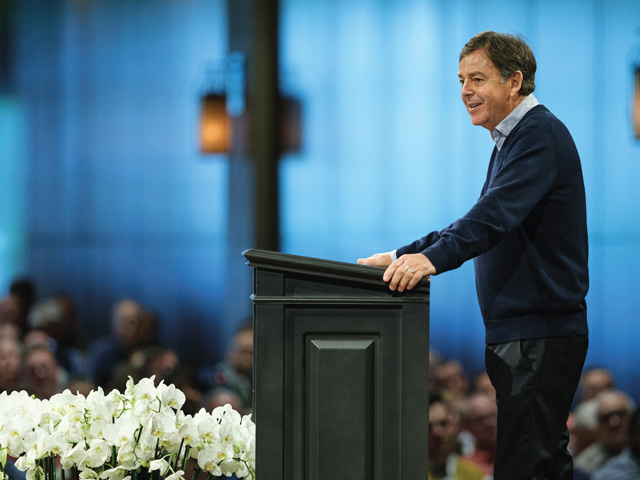
| The Lamb on the Throne in the book of Revelation may not initially look like a triumphant Messiah—but on Truth For Life, Alistair Begg explains how this image illustrates Christ’s humility as well as His unequivocal power, majesty, omniscience, and victory. |
References
Guest (Male): At first glance, the image of a lamb on a throne may not fit our idea of a Messiah who triumphed over sin and death and hell. But today on Truth for Life, Alistair Begg helps us understand how the Apostle John's imagery illustrates Christ's humility as well as his unequivocal power, majesty, omniscience, and victory. Let's open our Bibles to the book of Revelation, chapter 5.
Alistair Begg: John looks, he's told to look, Don't weep, see. And then look at verse 6, is it? Then I saw a lamb, looking as if it had been slain, standing to the center of the throne and encircled by the four living creatures. See the lion? He looks and sees a lamb. And we, like him, see the Lion of Judah only as he comes to us as a slain lamb. We see the Lion enshrined in the Lamb. And that's why in the second half of verse 9, when they're singing their new song, it is only in Christ crucified that they were going to discover the answer to their alienation and to their dislocation. Because you were slain and with your blood you purchased men for God. Because you see, the secrets of their world in the first century and the secrets of the world in our century belong to God. And none of us can pry into them. None of us knows what a day brings. None of us knows what will happen tonight during the night. Who knows what these next few months holds for us in Western culture? Especially if we feel it to be a dark and an unknown future. But we don't need Jesus as it were to come in order that we might be identifying the fact that our world is full of troubles. We can do that ourselves. We can look around and understand that, even as the recipients of this letter could. They didn't need anybody to appear out of the darkness and say, you know, you're in a very dreadful situation with all of this persecution and everything that's going on. They understood that. They didn't need Jesus to come and give them the information. They needed Jesus to come and give them the explanation. So that their troubles would not bring them down, perplex them and overwhelm them. Now the Lamb, which is presented to us here, is there as a further reminder to us of all of His humility. That Jesus is the one who became obedient unto death, even death on a cross. And when you stand back from this and you view it, you will see so clearly that what John is doing is he's reaching back into the Old Testament and he's picking up Old Testament pictures. He's picking up the picture from the Passover in Exodus chapter 12. He's picking up the picture of the suffering servant from Isaiah 53. Because the Old Testament worshiper was accepted on the basis of the sacrificed Lamb. And the New Testament worshiper, we as worshipers, are accepted on that same basis. Now if you look, you will see that it says, and in the NIV, it reads interestingly, "And I looked and I saw a Lamb, looking as if it had been slain." One of the other versions says, "standing as though it had been slain." And what is described here is the fact of the wounds in the Lamb, representing Christ's death by which He has achieved redemption, but this Lamb stands representing the triumph of His resurrection. "Then I saw the Lamb and He stood there looking as if He had been slain." And He was encircled by the four living creatures and He had seven horns and seven eyes, which are the seven spirits of God sent out into all the earth. Here we go again. Mrs. Jenkins, put the coffee on. The seven horns are an indication, at least, of His power and of His majesty. The seven eyes, a reminder of His knowledge and of His omniscience. It is always a dreadful pity if we stall in circumstances like this and miss what is clear and plain and central. And what is clear and plain and central is that this Lamb is confronting these readers as the only one who is able to take the scroll and open it and explain human destiny. And as the one who has died, the only one that is able to deal with sin and death and hell. And they are confronted by the Lamb as are we, as the one who has purchased their salvation. Because you were slain, again, verse 9, "and with your blood you purchased men for God." That is the price of our redemption. Once and for all Christ has paid this price. And when you go forward into chapter 7, and you find the description that is given there. One minute, they're described as 144,000. The next minute, they're described as a company that no one could number. One minute, they're described as the 12 tribes of Israel. The next minute, they're described as people from every tribe and nation and language and tongue and so on. And again, it's tenuous territory for some, but I think it makes perfect sense. From God's perspective, the number is absolutely perfect and finished and undeniable. From a human perspective, the number is an unraveling number of vastness, so vast that you can't count it. From God's perspective, the people that are redeemed are represented in his tribes. From a human perspective, the people that are redeemed are redeemed from every nation and tribe and people and language and so on. And what is the main and central aspect of it? Well, you have it right there when somebody asks, "Who are these people?" They're the ones who've come out of the great tribulation. They have washed their robes and made them white in the blood of the Lamb. In other words, they are the ones who are cleansed and they are clothed. They are the ones who are cleansed and clothed, and it is on account of that that they're before the throne of God, and they serve him day and night in his temple, and he who sits on the throne will spread his tent over them, and so on. In the words of one of our old hymns, "All these once were sinners, defiled in his sight, but now arrayed in pure garments in praise they unite. And unto him who has loved us and washed us from sin, unto him be the glory forever. Amen." They are the ones who have been set free from all that held them in its grip, in order that having been purchased by His blood, they might become men for God. Men and women for God. You have purchased them by your blood, that's the price, and the purpose is that we might be for God, not our own, bought with a price, living for Him. And when you think about it, in their day, as they looked around and they saw some of their friends taken into captivity. As they saw people from their community taken away, never to return. And as they tried to make sense of the triumph of Christ, and of the victory of His ascension, and of the reality of His return, somehow or another they had to make sense of it in light of everything that was going on around them. And if you don't think that what they lived through was a tribulation, I don't know what a tribulation might look like. And there they were. And someone must have said, well, you know, He purchased us for God. He purchased us for God. We exist for God. Our praise is about God. Our service is about God. The Lamb, the Lamb is all the glory. The Lamb is all the glory. How else do we make sense of missionary biography? How do I explain the girl with whom I studied, Mary Evans, wonderful Welsh girl, out, graduate, learning the Shona language so that she might teach young boys and girls in Zimbabwe. And how within a relatively short period of time, her life was swallowed up and snuffed out in a terrorist raid in the Pentecostal school in which she was teaching. And when in Newsweek magazine they represented it all, they said that in the raid that had taken place so many children and teachers had been killed and there was one Welsh missionary, and she was hanging on by a thread. By the time Newsweek was published, Mary Evans had gone to heaven. And when they gathered up all of her possessions and brought them home for her mom and dad, her parents who incidentally did not believe what Mary believed. Then they took materials, she was a singer and a guitar player and a lovely girl. And they took them and they played the cassette tape, and in the Shona language she was singing with the children, teaching them the song, "To me to live is Christ, and to die is gain. To hold his hand and to walk his narrow way. There is no peace, no thrill like walking in his will. For me to live is Christ and to die is gain." Loved ones, that is pure rhetoric, unless Revelation 5 is absolutely true. That he went to the cross in order to purchase us for God. So if all of our breath were to be squeezed out for God, if all of our life were to be trampled over for God, still, it would be time and energy well spent. Well, if the price is Christ's sacrificial death. If the purpose is in order that we might not be our own but be His. Notice that the scope is absolutely phenomenal. Who are these people whom He purchased? Well, they're from every tribe and language and people and nation. In other words, they're men and women from everywhere. You have it again in Revelation 7, don't you? And I looked in verse 9, "and I looked and there before me was a great multitude that no one could count from every tribe, people, language, standing before the throne and in front of the Lamb, and they were wearing white robes and were holding palm branches in their hands, and they cried out in a loud voice, 'Salvation belongs to our God, who sits on the throne and to the Lamb.'" And the privilege that was given to each who was present on this occasion was to become part of a kingdom, chapter 5, 10, part of a kingdom and priests to serve our God, and one day to reign on the earth. They will reign on the earth. It's interesting, they will reign on the earth. I'm so glad they're going to reign on the earth. I'm so glad there's going to be a new earth, aren't you? I mean, frankly, most of the stuff about heaven that I was told as a boy made me distinctly uncomfortable. You too. Even now, I'm not excited about it. I'll tell you straight up. I don't know what alabaster walls look like. And I've never played a harp. And the thought of playing one, especially for an interminable period of time, seems absolutely unattractive. Indeed if somebody said to me, would you like to go and get fish and chips in Sidmouth or play the harp in an alabaster hallway? I'd go for fish and chips in Sidmouth every time. I don't want to get off on a diversion here and I don't want to unsettle many of you. In fact, I want to encourage you. In a new earth, all the things that we have enjoyed in a fallen world will be rectified. Every friendship that is precious to us now will be even more precious to us then. The question of what you're going to do with your spouse or whatever else it is, should probably be subsumed under the absolute assurance that God will make everything that is a blessing and an encouragement and a help to us in this fallen world even better when He makes a new heaven and a new earth. And actually most of our pictures of heaven, most of our songs about heaven have more to do with Victorian Christianity and Platonic views of the universe than they have to do with a rigorous, thoughtful consideration of what God is actually planning to do. For the whole creation groans in travail, waiting for the redemption of the sons of God. Why? Because He is going to make a new creation. The ultimate purpose of God was not Adam and Eve in the garden. It was Christ in Gethsemane and it was His people in a new heaven and a new earth. For the cross of Christ was not something that was slotted into time in order to correct a defect in a system that had gone wrong. It was the eternal counsels of God's will that purposed in the view of man's inevitable rebellion that things would be this way. So we will sing His praises. I don't know about harps. I'm not unduly concerned about that despite my comments. We will worship the Lamb. We will do all of this. But again, even somebody said to me today, you know, they said, well, there's going to be a terrific time, a tremendous lot of singing, we'll just be singing, singing, singing, singing. I don't think so. I honestly don't think so. Frankly, I hope not, because I get tired singing. I really do. I mean, after a few songs, I'm done for the night. And I don't think eternity is just makes that all different. No, there'll be parks. There'll be fishing. There'll be sunsets. We say no, there's no sun. Bring me back again and we'll do a complete series on this, all right? Because I got to stop. Somebody says from the back, given your last five minutes, you'll never be back again, but that's okay. That's entirely all right. Let me end in this way. Notice the ever-expanding circle of praise that is described here. And remember, in the book of Revelation, again, that's why I said, and I wasn't being facetious, it's like a comic book. Do you remember those books you used to get? At least we did when I was the small, I don't think they still have them, the like the war books, they were comics. And with the drawings in them. And you could just, you could read the dialogue if you wanted, but if you just looked at it, you said, I get the point here. And then you look at the next page, you pretty well follow along, even if you couldn't read. In other words, if you stood far enough back from it and just looked at the picture, you say, I think I get the plot here. In the same way, if you take the book of Revelation and stand far enough back from it, I think you'll get the plot. If you get your nose too far into it and start fiddling around, there's no telling what you'll get. You might get a rash for all I know. And the story is just essentially this: Jesus wins. Jesus wins. See? I mean, that's really what it is. That's what he's saying because the people are saying, "We're finished. Look at us. We're getting smaller by the day rather than bigger. Jesus was here but he's gone. He said he would come back but there's no sign of him. Meanwhile, the Roman authorities are getting worse by the minute, and they want us to keep saying to one another, when we meet each other in the street, Caesar is Lord. But we can't say Caesar is Lord because he's not. We must say Jesus is Lord." And every time we say Jesus is Lord, they haul one or two of us away and give us a royal hiding. Well, don't worry about it, we've got a great book for you here. It's all about Israel and 1948 and 1991 and 2009 and 1946 and everything else. It's going to be you really love it, you know, it's going to really help you. How? No, don't be silly. He writes to these beleaguered individuals. Of course, the book has a forward thrust. It's not irrelevant to our age. But isn't it interesting that in every generation, especially the closer we get to dying, everybody that I've ever met says this is the end of the world. It's coming. Jesus is coming back tonight. Because you hope so, because you don't want to go in a coffin. And neither do I. And everybody does it. No, this is the thing, you see. You look and you say, now what do we have here? We have the Lamb, slain from the foundation of the world. He is the one who steps forward both as Lion, as Lamb. He is the one who has the keys that are able to unlock the scroll of destiny. He doesn't tell us everything. The language that is used is multivarious, it's eschatological, it's metaphorical and so on. It's very hard to deal with, and if you stand far enough back from it, you'll get the picture. And you will be invited to join in the ever-expanding circle of praise. Verse 8 of chapter 5, "And when He had taken the scroll, the four living creatures and the 24 elders fell down before the Lamb. Each of them had a harp, they were holding golden bowls full of incense." Good for them. "Which are the prayers of the saints." All right? That's the first circle. Go to verse 11. "And then I looked and I heard the voice of many angels, numbering thousands upon thousands and 10,000 times 10,000." And they encircled the throne, and the living creatures and the elders, and in a loud voice they sang. That's the second concentric circle, going out the way. Then verse 13. "Then I heard every creature in heaven and on earth and under the earth and on the sea and all that is in them singing to him who sits on the throne and to the Lamb, be praise and honor and glory and power forever and ever." And the four living creatures said, "Amen." And the elders fall down fell down and they worshiped. You see what's happening? He's given them this picture of absolute, total triumph. Eventually, basically what you have here is Philippians 2. One day, at the name of Jesus, not just the four elders and the 24 and whatever, one day at the name of Jesus, every knee will bow and every tongue will confess that he is the Lamb, slain from the foundation of the world. By whose blood our sins are cleansed. With whose righteousness we are clothed. And in whose company we will live for all of eternity. Whatever it's going to be like. And remember what I told you earlier. You don't have to pay one bit of attention to all my silly stuff. You are sensible people. Read the Bible for yourselves. And remember, the main things are the plain things, and the plain things are the main things. Samuel Rutherford, and we stop. Rutherford, Scottish divine. Some of you have read his letters and his memoirs. Margaret Cousins, who was the wife of one of his minister friends, took some of his materials and wrote a very long poem. And out of that very long poem, somebody chose about six stanzas and wrote a hymn, and you know what it was. It begins, "The sands of time are sinking." Remember, "and the dawn of heaven breaks." And it is wonderful in its picturesque language. And it concludes in this way, "The bride eyes not her garment, but her dear Bridegroom's face. I will not gaze on glory, but on the King of grace. Not on the crown he giveth, but on his nail-pierced hand. For the Lamb is all the glory in Emmanuel's land." And whatever that will mean, and however that will look, because God has promised to bring to completion the good work that he has already begun in the lives of his children. If I don't see you before, I will try and find you and perhaps we can either go fishing or maybe just play the harp for a little while in the afternoons.
Guest (Male): You're listening to Truth For Life with Alistair Begg. Today's message wraps up a series titled "To Know Christ." We hope you have benefited from this exploration of what the Gospels have to say about the identity and work of Jesus. If you'd like to take a deeper dive into getting to know Jesus, there's a companion study guide for this series. It includes nine lessons that correspond with each of Alistair's messages. It's perfect for personal use or for a small group Bible study, and you can download the study guide and the complete series for free today. Just visit truthforlife.org/knowchrist. That's K-N-O-W, know Christ. Today's also the last day we'll be featuring the book "Christ Our All, Gaze at Him." So if you've not already requested your copy of this 14-day devotional, you'll want to do that today. The devotional is yours today for a donation to Truth For Life. You can give online at truthforlife.org/donate or you can call us at 888-588-7884. Thanks for listening. If you ever find yourself fearful that you're just not smart enough or your life circumstances will somehow prevent you from being used by God, tomorrow we'll learn how He often uses unlikely individuals and unexpected means to fulfill His purposes. The Bible teaching of Alistair Begg is furnished by Truth For Life, where the learning is for living.
Related Episodes
Lamb on the Throne (Part 1 of 2)
Tuesday, July 14
Divine King (Part 2 of 2)
Monday, July 13
Divine King (Part 1 of 2)
Saturday, July 11
About Truth For Life
Truth For Life distributes the unique, expositional Bible teaching of Alistair Begg. Studying God’s Word each day, verse by verse, is the hallmark of this ministry. In a desire to share the good news of the Gospel without cost as a barrier, the entire teaching archive is available for free download and resources are available at cost with no markup.
About Alistair Begg
Alistair Begg has been in pastoral ministry since 1975. Following graduation from The London School of Theology, he served eight years in Scotland at both Charlotte Chapel in Edinburgh and Hamilton Baptist Church. In 1983, he became the senior pastor at Parkside Church near Cleveland, Ohio. He has written several books and is heard daily and weekly on the radio program, Truth For Life. The teaching on Truth For Life stems from the week by week Bible teaching at Parkside Church. He and his wife, Susan, were married in 1975 and they have three grown children.Contact Truth For Life with Alistair Begg
Website
http://www.truthforlife.org/?utm_source=oneplace&utm_medium=sitelinks&utm_campaign=home
Mailing Address
Truth For Life
P.O. Box 398000
Cleveland OH 44139
Telephone (Customer Service)
888-588-7884 Domestic
400-543-6800 International
440-543-0522 ( Fax)


