A Charge to a Man of God (Part 3 of 3)
Ministries > Truth For Life with Alistair Begg
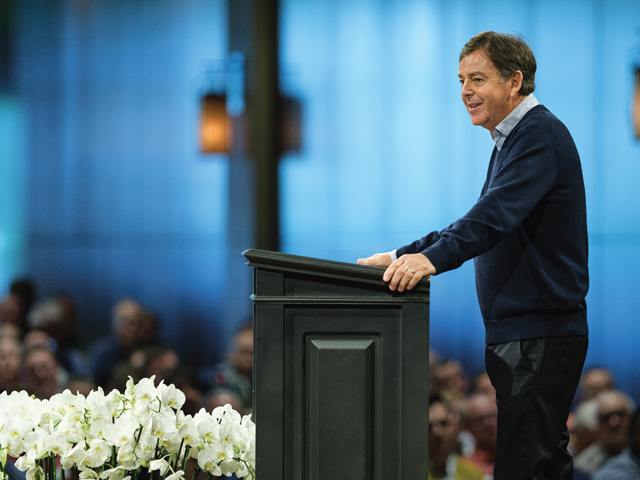
 Paul taught that God’s children should flee from false teachers, the love of money, and other dangers. But it’s not enough to run from ungodliness. We also need to be purposeful in what we run to. Learn what we’re to pursue on Truth For Life with Alistair Begg.
-----------------------------------------
• Click here and look for "FROM THE SERMON" to stream or read the full message.
• This program is part of the series A Study in 1 Timothy, Volume 2’
• Learn more about our current resource, request your copy with a donation of any amount.
• In one of the most famous sermons ever preached, Jesus explains that the values in His kingdom are vastly different from the world’s values! The poor will be blessed, those who weep shall laugh, and the hungry will be satisfied. What does this mean? Download the free ebook and study guide The Christian Manifesto by Alistair today at ‘truthforlife.org/manifesto’
Helpful Resources
- Learn about God's salvation plan
- Read our most recent articles
- Subscribe to our daily devotional
Follow Us
YouTube | Instagram | Facebook | X
This listener-funded program features the clear, relevant Bible teaching of Alistair Begg. Today’s program and nearly 3,000 messages can be streamed and shared for free at tfl.org thanks to the generous giving from monthly donors called Truthpartners. Learn more about this Gospel-sharing team or become one today. Thanks for listening to Truth For Life!
Guest (Male): The apostle Paul taught that God's children ought to flee from false teachers and from the love of money along with other dangerous diversions. But it's not enough to just run away from ungodliness. We need to be purposeful in the things we are running to. And today on Truth for Life, Alistair Begg highlights two virtues we ought to be pursuing. We're studying 1 Timothy chapter 6.
Alistair Begg: The directive of Paul can be seen in these two verses by focusing on the imperatives, the verbs which he uses to call Timothy to a particular life of action as he exercises his duties in pastoral ministry. Now his first word to him that we noticed last time was the word flee. And he has been talking about an inordinate love of money, the mistaking of godliness as a means of gain, squabbling and unhealthy interest and controversy and so on. Timothy, he says, don't let your ministry be marred by these things. Instead, knowing what you must flee, let me tell you now what you must pursue. Do you remember we said last time that our Christian maturity can in large measure be determined by asking ourselves, what am I running from and what am I running to? So he has moved from the flee to the follow, if you like, pursue. The way hounds chase a fox, a single focused commitment to a clearly understood objective. And the Christian life has clearly understood objectives. We are not simply wandering aimlessly in the track of Jesus of Nazareth. We're not simply interested in doing whatever takes our fancy or being swayed by one particular group going in one direction or by going with whatever our instinct on a particular day happens to be. Not if we are determining to go the way of Christ. Not if we are going to go the way of Paul. Now so he says, I want you to pursue these things and let me tell you what they are. And he lists six virtues. First of all, and together righteousness and godliness. Pursue righteousness and godliness. is the word that is used for righteousness here. And when you find it, refer to people in the New Testament, it virtually always conveys the idea of conduct that is in accord with God's will and is pleasing to him. Now like all Christian virtues, this is brought about by the transforming work of Christ. Paul is not calling these individuals here to try and muster up in their own strength a certain kind of lifestyle. The Christian life is not like a Christmas tree with ornaments attached that can be easily disengaged. But the Christian life is like a genuine tree which has grown through the winter time now and is beginning to produce buds on the on its branches. And the reason that there are buds appearing on the branches is because there is life within the trunk. And what he is reminding these people of is that the life of Christ as it pulsates through the believer will evidence itself in a number of ways. So we are actually being called to pursue what it is that God by his spirit is determined to produce. So there need be no concern that we're going to be unachievers or poor achievers because as soon as we as it were put our hands to the plow, we discover that God works by his spirit to enable us to that which he has called us. It is that which God engenders within us that he then calls us to pursue because by nature we don't want to do the right thing. By nature we want to do the wrong thing. By nature we err and stray from his ways like lost sheep. So the word of God comes to shine on our path and say, do you want to know how to be righteous? Read this book. 2 Timothy 3:16 All scripture is inspired by God, is useful for teaching, rebuking, correcting and training in righteousness. So there isn't need to be a great mystery about it. You say, okay, I understand. I haven't been pursuing righteousness. I want to pursue righteousness. What should I do? Read your Bible. What should I do? Study the word. What should I do? Sit under the instruction of God's word. The righteous judge has a crown of righteousness laid up for those who pursue righteousness. And it is not that in our pursuit we seek to make ourselves acceptable to God. It is in our pursuit that we reveal the wonder of the fact that God in Christ has accepted us. Now to that word he adds the word godliness, And this word godliness he has used again with frequency throughout in verse two of chapter two he urges them to live quiet lives in godliness and holiness. In verse 16 of chapter three he says the mystery of godliness is great. In chapter six in verse six he says godliness with contentment is great gain. So it's hardly a surprise when he says, okay, Timothy, let me tell you not what to chase or what not to chase. Let me tell you what to chase. Chase a rightness in your conduct and chase a godliness in your dealings. Now the word godliness or spiritual fitness is expressive of an old word which has fallen into disrepute. And the word is piety. And the word piety is usually mentioned in a kind of negative and derogatory term even when it is mentioned amongst believing people. It would be one thing if those who are secular sought to distance themselves from what they thought was pious. But the remarkable thing is to move in the company of God's people and hear them talking about piety and dismissing it. Do you understand what we're dismissing? We're dismissing what Paul says to Timothy we are to pursue. We can dismiss what we are to pursue without impoverishing ourselves, reducing our impact in the surrounding culture. And one of the reasons that we have such little impact is because we have distanced ourselves from the very things that will make us distinctive. Church doesn't make us distinctive in itself. Religious interest doesn't even make us distinctive. A concern for spiritual things only puts us on a par with millions of people all across this nation. It's going to have to be something else and it is. Now there is no question that there is a legalism and a self-deceit that is wrapped up in false kinds of piety. Jesus abhorred that stuff in the Pharisees. He told them, hey, I hope you enjoyed the people looking at you and saying, my, that's a long prayer. He says because that is all the reward you're getting. I hope you enjoyed putting your money in the box, he said, and having the people look and say, my, looks like he dumped quite a bit in there. Jesus says, I hope you enjoyed that because that's all that you're getting. Said, but if you want to practice your deeds of piety, go in such a way that you don't let your left hand know what your right hand's doing. And your God who sees in secret will reward you openly. And when you say your prayers, go into your closet and close the door and express the intimacy of your dealings with God in that way. Don't use the public forum as a profile for the displaying of your own particular affections. That's what he was saying. Don't draw attention to yourself. Be godly. Be pious. Now I got stuck on this, I must tell you when I was studying and so you're going to get stuck here for a wee while yourselves because this hit me like a 2x4 just right on the head. I never got past godliness. Said, okay, godliness. Would anybody ever say, ever use this description in relationship to my life and conduct? See that's the real test. Forget the congregation for a moment. I'm preaching this sermon to myself up the stairs here. You just get to hear stuff that that I preach up the stairs. And I went then back a few years actually to the 17th century to find a book by Lewis Bailey called the Practice of Piety. And it has been quite staggering to read this. And I want to read just a couple of comments to you from it. And the this will take time, but I believe me, I'm not trying to fill in time. It's a little archaic and I have to read it slowly. And but let me give you this is the thought that struck me. There seems to be a direct correlation between the ordering of a life in terms of the use and abuse of time, money, talent and appetite. There's a correlation between the way in which we use those resources that God has given us and the experience of a pursuit of godliness or otherwise. And I further said to myself, I'm not sure but that my life at the moment isn't completely set up to mitigate against the very thing that I being called to pursue. That all of the elements that are in it, all of the time that is expended, all of the the bits and pieces that are there as with your lives and I don't mean for one second that I would be distinct in that. I'm assuming myself to be standing beside you in these observations, but I'm saying to myself, I think the whole structure of my life prevents the pursuit of godliness. And it was driven home when I began to read Bailey again whom I have read before and quoted in in I I think made for his pleasure. But let me give you a little flavor of it what I'm meaning by this. He he has a chapter entitled Duties in the Holy Assembly which being interpreted is what you ought to do when you're in public worship. And he has a subsection entitled when the sermon is ended. So he says when the sermon is ended, beware thou depart not like the nine lepers. Till for thine instruction to saving health thou hast returned thanks and praise to God by an after prayer and singing of a psalm. And when the blessing is pronounced, stand up to receive thy part therein and hear it as if Christ himself, whose minister he is, did pronounce the same unto thee. For in this case it is true, quoting Luke 10, he that heareth you heareth me. And the Sabbath day is blessed because God hath appointed it to be the day wherein by the mouth of his ministers he will bless his people who hear his word and glorify his name. That loved ones is what we believe about the preaching of the word. That is why we want silence when we preach. That is why we want the opportunity to have any kind of interference removed because we actually believe that the mouth of God is heard through the mouth of a man. Is it wrong to anticipate that? You see it is because we have such a low view of what is taking place in preaching that we would accommodate every other imaginable thing along with it. But as soon as we would think for a moment that God himself would speak through the voice of a mere man, then it changes the agenda completely. And he says it is on the Lord's day that he is appointed that by the mouth of his ministers he will bless his people. That's why you don't ever want to get up here unless you're sent here. You don't want ever think for 15 seconds that it would be easy or good or fun or whatever else it is. It is a solemn, sobering thing to stand between almighty God and the people of God, knowing that you will give an account for every word you have spoken. And when the people of God understand that that is what is taking in the preaching of the word, then it becomes a whole different business. And Bailey says in the pursuit of godliness you will understand it. Now he goes on and he says the third sort of duties after the holy assembly he goes through all these duties about when you leave church, what do you do next? He says as thou returnest home or when thou art entered into thy house, meditate a little while upon those things which thou hast heard. And as the clean beasts which chew the cud the graphic picture so must thou bring again to thy remembrance that which thou hast heard in the church. Says you want to be godly, this is what it takes. You don't bring your thimble, fill it up, spill it in the parking lot, get in your car, turn on a secular station and blast off for lunch. Not if you want to benefit from the preaching of the word of God. Well he then says he's not finished. Says you go home, you regurgitate something that you learned and you chew on that for a while. And then kneeling down turn all to prayer, beseeching God to give such a blessing to those things which you have heard that they may be a direction to your life and a consolation to your soul. For till the word be thus made our own and as it were close hidden in our hearts, we are in danger lest Satan steal it away and we shall receive no profit thereby. I'm thoroughly convinced that this is what happens. You know the Jesus says, you sow the seed, it falls on the path and the birds come and eat it up. We unleash the birds. I have a whole flock of birds that I can do I just unleash for myself. Nobody else needs to do them. I'm doing it. I'm snatching my own food from myself. See it's not externalism. Pharisees had it down on the outside. Jesus said, this is bogus. It's not we're not talking about that. That 's why we have to principleize this. He was this guy, you know, he didn't have a car. He had a horse if he had anything. I mean he had he was walking everywhere. Life is different. I understand that. But principally and when thou goest to dinner in that reverent and thankful manner before prescribed, remember according to thy ability to have one or more poor Christians whose hungry bowels may be refreshed with thy meat, imitating holy Job who protested that he never did eat his morsel alone without the good company of the poor and the fatherless. So in other words, this practice of piety is not something whereby we go off on our own and have a little holy club. No no, he says there are people who need food. There are people who need help. Don't sit down and eat. Bring them with you. Talk about a church making an impact. No wonder the social services are going nuts because the church doesn't do it. If the last 20 years in America had seen local churches taking seriously the call of God to what is clearly delineated for the people of God instead of running around trying to elect everybody then I wager that we would would be in a far different position than we are in today. I mean there I better not start. I I can't start. Now when we discount it for the passage of 300 years we cannot distance ourselves in all honesty. At least I can't. From the fact that I cannot blame the culture for what I do. It influences me. I do what I do and you do what you do. And do you understand why it is that in certain places and certain times people have chosen to take to themselves stringencies as an act of self-discipline and self-abnegation. Not to draw attention to themselves, but to remind themselves before the watching world that they are a peculiar people. The problem with it is it so often has ended in mere externalism. So what I am trying to say is simply this. When he says pursue righteousness and godliness we're going to try with his help. I don't know how it'll change, what it'll change. I don't know how obedient you'll be, how obedient I'll be. We must work out our own salvation with fear and trembling, but I know this that godliness has to be a distinctive. Now I had a lot more to do, but I won't. We'll just stop, but I I I want to come much closer in time and go to the 18th century and and finish with another quote. You know, I'm reading this book about William Grimshaw. He made this covenant with God. He tells us on the 4th day of December 1752 when he was the minister of Haworth, which is the little place in Yorkshire where Emily and Charlotte Brontë's father was also the minister 80 years after William Grimshaw. He tells us that I renewed this solemn dedication in a most awesome manner on the 5th of June 1760. And he says, all that I may carefully remember and keep it. I like that. You know, it's one thing to make it, it's another thing to renew it, it's another thing to remember it, it's another thing to keep it. There's a there's a freshness about this fellow. And he says, I purpose to renew this dedication with a quarterly fast, the first Friday in January, April, July and October during the rest of my life. Let me give you just a flavor of it. I found it so challenging in relationship to this notion of pursuing righteousness and godliness. He says, record, O eternal Lord, in thy book of remembrance that henceforth I am thine forever. From this day I solemnly renounce all former lords, world, flesh and devil in thy name. No more directly or indirectly will I obey them. I renounced them many years ago and I renounced them forever. This day I give myself up to thee a living sacrifice, holy and acceptable unto thee and which I know is my reasonable service. To thee I consecrate all my worldly possessions. Use me, O Lord. I beseech thee as the instrument of thy glory and honor me so far as either by doing or suffering thy appointments I may bring praise to thy name and benefit to the world in which I live. And may it please thee from this day forward to number me amongst thy peculiar people that I may no more be a stranger or foreigner, but a fellow citizen with the saints and of the household of God. And when I am thus numbered with the dead and all the interests of mortality are over with me forever if this solemn memorial should fall into the hands of any surviving friends or relatives you see here is piety. He didn't write this and have it published. He didn't write this and confront his children with it. This was just between he and God. And the real issue, loved ones, is what is going on between you and God and me and God. People will observe, approximate, decide, criticize, whatever else it is. But the real issue is in the silent place where our hearts are laid bare before God. What will they find when they go through our papers? What will my children find when they find that which they do not know today? Financial statements? He says if this should fall into the hands of any and it's fallen into ours, may it be the means of making serious impressions upon their minds and may they read it not only as my language, but as their own and learn to fear the Lord my God and with me to put their trust under the shadow of his wings for time and for eternity. And may they also learn to adore with me that grace which inclines our hearts to enter into the covenant and condescends to admit us into it when so inclined, ascribing with me and with all the nations of the redeemed to the Father, Son and Holy Ghost that glory and honor and praise which is so justly due to each divine person for the part he bears in this illustrious work. I solemnly subscribe this dedication of myself to the forever blessed triune God in the presence of angels and all the invisible spectators this 4th day of December 17 52. Surely we are surrounded by a great cloud of witnesses. Those who have gone before, who have run the race, who have fought the fight, who have kept the faith. Paul says to Timothy as a young man in his day, Timothy, I don't want you to get sucked into unhealthy controversy. I don't want you to get involved in all this squabbling. I want you instead to stay away from that and I want you to pursue the way the hounds pursue a fox, righteousness and godliness. May God help us.
Guest (Male): You're listening to Truth for Life with Alistair Begg. You know, Alistair asked an important question that I think all of us should be asking ourselves at every age and stage of life. The question is what's going on between me and God. Once we reach a certain age, sometimes we're inclined to look backward more than we look forward. Maybe you're at an age when your children have grown up, your career is winding down. Maybe you have regrets about things you've done or things you've failed to do. I want you to hear this. God is not done with you yet. And that's the topic of a book we are recommending to you today, a book called Not Old, Not Young, Not Done Following Jesus in your 50s and 60s. Ask for your copy of the book when you donate to Truth for Life today. Go to truthforlife.org/donate or call us at 888-588-7884. Thanks for joining us today. Are you prepared to take an unequivocal stand for Jesus like Timothy did? Tomorrow we'll find out what that involves. The Bible Teaching of Alistair Begg is furnished by Truth for Life where the learning is for living.
Related Episodes
We Do Not Lose Heart (Part 2 of 4)
Saturday, October 24
The Good Confession (Part 1 of 2)
Friday, October 23
A Charge to a Man of God (Part 2 of 3)
Wednesday, October 21
About Truth For Life
Truth For Life distributes the unique, expositional Bible teaching of Alistair Begg. Studying God’s Word each day, verse by verse, is the hallmark of this ministry. In a desire to share the good news of the Gospel without cost as a barrier, the entire teaching archive is available for free download and resources are available at cost with no markup.
About Alistair Begg
Alistair Begg has been in pastoral ministry since 1975. Following graduation from The London School of Theology, he served eight years in Scotland at both Charlotte Chapel in Edinburgh and Hamilton Baptist Church. In 1983, he became the senior pastor at Parkside Church near Cleveland, Ohio. He has written several books and is heard daily and weekly on the radio program, Truth For Life. The teaching on Truth For Life stems from the week by week Bible teaching at Parkside Church. He and his wife, Susan, were married in 1975 and they have three grown children.Contact Truth For Life with Alistair Begg
Website
http://www.truthforlife.org/?utm_source=oneplace&utm_medium=sitelinks&utm_campaign=home
Mailing Address
Truth For Life
P.O. Box 398000
Cleveland OH 44139
Telephone (Customer Service)
888-588-7884 Domestic
400-543-6800 International
440-543-0522 ( Fax)


