Matthew 5:42—6:34
Ministries > Thru the Bible with Dr. J. Vernon McGee
https://www.oneplace.com/ministries/thru-the-bible-with-j-vernon-mcgee/
Facebook Twitter Instagram YouTubeWhen asked by His disciples to teach them to pray, the Lord gave them an example, what we call “The Lord’s Prayer.” Our study in Matthew 6 teaches us how our inner motives govern our external acts of righteousness. Great wisdom for conducting your business, raising your children, or supporting ministries doing God’s work.
References
Steve: What principles guide your life, the way you raise your children? How about the way you invest your time, your resources, or maybe how you support God's work? Well, those decisions don't just happen. They flow from something deeper. Welcome to Thru the Bible. As we continue learning about the Sermon on the Mount, Dr. J. Vernon McGee takes us straight to the heart of the matter. This powerful message isn't just about outward behavior, though. It's about the inner motives that shape our actions. The righteousness that Jesus describes begins on the inside and then works its way out. I'm Steve Schwetz, and I'm glad that you're on the Bible bus with us. Go ahead and open your Bible to Matthew chapter 5, verse 42. And as you find it, Greg and I will share a few notes from listeners who hop aboard this time via the app.
Greg: Yes, Steve, we're excited because we have been able to build over a hundred different language apps that have the TTB systematic teaching and the Bible. It's that simple. And there is an easy way to respond and give feedback through the app. All of these testimonies came through our various app feedback systems.
Steve: Yeah, this first one comes, and you would think, oh, it's in the US. No, this comes from Mario in Argentina who listens to our Spanish app. Listen to this. When I was a child, my parents used to listen to this program on the radio. They are no longer with us, but thanks to the Lord, a sister in Christ told me about the app. I downloaded it and now I enjoy the teachings every day. My life is spiritually enriched, and I always recommend the app and share the studies as well. May our Heavenly Father fill you with His grace until His coming. That is my greatest desire.
Greg: And thanks for pointing out that this Spanish listener is in Argentina. That is the reason that we have invested in digital ministry is the footprint is basically the whole world except where there is no internet access. And that's increasingly a small part of the world. So this this is a powerful way for us to fling the seed of the Word of God. Now we can go from Argentina to Alabama. And Robin tells us her Thru the Bible story. She says, back when I was a kid, my mom used to listen on W J M M in Lexington, Kentucky. She still does. I'm 62 years old now. I recently looked you up and downloaded the app. I'm in Revelation, and let's say that I am hooked. I have learned so much already and cannot wait each day to listen at my convenience. I've had some questions answered and explained in ways that I understand. I am so looking forward to going ahead with you all, and don't know why I have waited so long. Thank you for providing this app and a way to follow along. I'm already working on getting my friends hooked up and we'll be talking to my pastor. We recently went through the whole book of Revelation on Sunday nights.
Steve: Robin, thank you so much for that encouragement and for sharing the app with your friends. And for those of you who want to be able to do the same, you can always download it from one of the app stores. And you can also get a pack of ten of these little, we call them Bible bus passes, about the size of a business card. You can keep them with you, super easy. You can just say, hey, can I share something with you that's had an impact on my life? Hand them the card, they can scan the QR code, and they're on the Bible bus at that point too.
Greg: And that QR code takes you to a website with all 100 apps, the English plus the other languages. So, if you meet someone that speaks another language, you can do that as well.
Steve: Yep, that's great.
Greg: Steve, how about what Debra had to share?
Steve: Okay, this is in 2020. I was hospitalized due to World Trade Center illness for five months. When I returned home from rehab, I was alone a lot, but very grateful to God in the name of Jesus for being alive. I discovered the program and have been on the Bible bus since then. It's my first go-round, and waiting to ride the bus again. You have helped me to live a better life as a Christian. I thank God for all of you.
Greg: And so Steve shared with you, you can go to any of the major stores, the Apple Store or the Google Play Store and download our app. Just type in Thru the Bible, T H R U, the Bible. And you will be able to, as Robin pointed out, you can study anytime, as many times as you want. That's one of the other great things about these apps. They're such great tools for study.
Steve: Yeah, Greg, why don't you pray for us as we begin?
Greg: Father, thank you for the technology that allows us to make your word available to more and more people. And now as we all turn our hearts and minds to your word, we pray for you to open our hearts and change our lives in Jesus name. Amen.
Steve: Now our study of Matthew 5 continues on Thru the Bible with Dr. J. Vernon McGee.
Dr. J. Vernon McGee: Now we come in this chapter to see something that's very important, and it's the relationship of the subjects of the kingdom to God and the inner motives which govern external acts of righteousness. And here we'll see the giving of alms, prayer and fasting and the getting of riches. All of these are very important by the way. And we see the relationship of the citizen of the kingdom of heaven to God. And you'll notice that when we concluded last time in chapter 5, and I rushed through that last section rather hurriedly. We made the statement that business could not be conducted today by this law here. Archbishop McGee of Ireland years ago said that it was impossible to conduct the affairs of the British nation on the basis of the sermon on the mount. Now, I do not know whether I'm related to Archbishop McGee or not, but I certainly find that I think as he did about the sermon on the mount. This can only be enforced when he is on the throne, that I think ought to be quite obvious. Give to him that asketh thee and for him that would borrow thee turn not thou away. And so many of the wealthy churches today, they attempt to follow, they say, the sermon on the mount. That's their regular diet. Well, you go out and try to get something from the rich and see how far you get today, my friend. You won't get very far. I can assure you. Because they don't really live by it. They say it's a great document. All they do is they just think it's great. That's all. They hear about it on Sunday, but Monday morning, it's just cold-blooded business and cash on the barrel head or you don't get it. And that, of course, is the way the business world is set up today. But there's a great principle here for the child of God, and we shouldn't miss that. We should try to be helpful to those that are in need. And there's so many kind Christian acts that can be performed today by believers. And after all, there were no hospitals or orphan's homes or works of charity. The Bible doesn't call it that. Acts of love that have preceded the preaching of the gospel, always followed it. And the proof, of course, is the fruit is the important thing. And there is a great principle here and it concluded by saying that we're to be perfect, even as your Father which is in heaven is perfect. And how can you be perfect? Accepted in the beloved, in Christ. Those that are in Christ Jesus, there's no condemnation to them. God sees us in Christ. And you get there by faith in Him. That's the only way that you can become perfect is through faith in Christ today. Then there begins that slow process of sanctification in our lives. And this, of course, should be a goal. But to say that you can automatically in your own strength attain it, and then go to God and say, look what I've done, look how wonderful I am. And you get all the glory, and you force God to save you on that basis. And my friend, you're going to do nothing of the kind because you and I are not perfect. And it's only in the little nursery rhyme that the little fellow that reached in his thumb, pulled out a plum and said what a smart boy am I. We got a lot of that in religion today. The little folk that sit around and reach in their thumb and pull out a plum, and they say, my, what a smart boy I am. My friend, may I say to you, you and I need a savior today. Now we're dealing here in chapter 6 with the externalities of religion. That's very important to see. In chapter 5, the king speaks of the righteousness which his subjects must possess. And it must be a righteousness to exceed the righteousness of the scribes and Pharisees. Now, they had a religious righteousness. That man Nicodemus was an outstanding man, and he was religious. You can't find much to criticize about him, but our Lord said to him, you have to be born again. Now, we have to have a righteousness superior to that, and that only comes through trusting Christ. Now, in this chapter, he talks about the righteousness that the subjects of the kingdom are to practice. And the motive, of course, is important thing in doing for God. No third party can enter into this relationship. These things are between the soul and God. And the things that are mentioned here are the giving of alms. The second thing is prayer. The third thing is fasting. The fourth thing is money. And the other thing is taking thought and care for the future. These are very practical considerations. Now, listen to him here. He first talks about alms. And this all has to do with the externality of religion, our ostentation in what you do in a religious way. Now, notice this. Take heed that you do not your alms before men to be seen of them. Otherwise, you have no reward of your Father which is in heaven. Now, your giving is between you and God. And you do not give to be seen of man. This is a great principle here. Now, notice what he says, and he uses very strong language. He says, therefore, when thou doest thine alms, do not sound a trumpet before thee, as the hypocrites do in the synagogues and in the streets, that they may have glory of men. Verily I say unto you, they have their reward. He said this with biting irony and with a rapi of sarcasm. And our Lord knew how to use that. It was the custom of the Pharisees, when they wanted to give to the poor, they go down to a corner, a busy corner in Jerusalem, and they'd blow a trumpet. The purpose of it was, of course, was to call the poor and needy together to receive the gift. But it also afforded a very fine opportunity to let others know how generous they were. Aren't they parallels to some Christians today? Listen, he says, when they do it that way, they have their reward. And you ask the question, well, what is their reward? Well, what was it they were after? They did it to be seen of man. They were seen of man, they blew a trumpet, and everybody came running out. And that was their reward. It wasn't between them and God. Now, why do you give? I've been told that a certain man. I remember several years ago, I was asked to take an offering in a certain organization. And they said, now the thing that you want to do is to make sure that you give everybody an opportunity to stand up and say how much they'd give. And the way you do it, you say, how many give a hundred dollars? And I said, well, why in the world are you doing it like that? Well, Mr. So and so's here. If you just take an offering, he'll put a dollar in. But if you let them stand up and say who's going to give a hundred dollars, he'll stand up and give a hundred dollars, and he'll give it too. May I say he blew a trumpet. And I came to know the man. I came to discover that's the way he gave. I've had many folk that when they'd give you a very large check, and they'd give it to you personally, and I had a man that always gave me that check before I went into the pulpit. He was very smart in doing that because he thought it would excite me enough that I'd get up and mention it. And a friend of his came to me one day, and he said, so and so's disturbed. He gave you a check the other day, and you didn't get up and acknowledge it. And may I say to you, I didn't. And I told this man the reason why. I said, now this man's a man of means. The check he gave in relationship to what he has isn't very much. But I said, there happened to be a mail carrier also that handed me an envelope. And he didn't want me to open it till after the service, and he didn't want me to say a word to anybody. And he gave almost twice as much as that man gave. May I say to you, if I'm going to acknowledge anybody, I'm going to have to acknowledge the other man, but he wouldn't want it. May I say to you that giving is between you and God. And the very minute that you get a third party in there, then you don't get any credit for it at all. I think there's a lot of so-called Christian giving today. The college I graduated from, they sure played on human nature. They sent out a beautiful architect's drawing of a tower. They were going to put on the old hall that was there when I was in school. And they very, you know, modestly said, and we, of course, name it after the donor. And I understand they had a half a dozen that wanted to give because that tower is known. It's called So and So Tower in honor of that man. Well, that trumpet's been blown all the time. The fact it's on there in stone, carved in stone. A lot of people give like that. Now, that kind of giving is worth nothing before God. Notice what he says, verse 3 of chapter 6. When thou doest alms, let not thy left hand know what thy right hand doeth, that thine alms may be in secret. And thy Father which seeth in secret, himself shall reward thee openly. Don't reach in your pocket with one hand and then put the other hand in the air to let people know how much you're giving. When you put that hand in your pocket to give, just don't let the other hand know what you're doing. That's what our Lord is saying. Oh, this is biting sarcasm. Do you really live by the sermon on the mount, my liberal friend? I don't think you do. Now, verse 5. And when thou prayest, thou shall not be as the hypocrites are. My, our Lord uses strong language, doesn't he? For they love to pray standing in the synagogues and in the corners of the streets that they may be seen of man. Verily I say unto you, they have their reward. Now, they pray to be seen of man. You know, they have a prayer shawl. A man goes around wearing that prayer shawl. That means he's in prayer. And that's to advertise he's praying. He says that if they pray like that, they have their reward. What is their reward? Well, their reward is they want to be seen of man. They're seen of man, but their prayers are not answered, it never gets above the rafters of the building. Verse 6, but thou, when thou prayest, enter into thy closet. When thou hast shut thy door, pray to thy Father which is in secret. And thy Father which seeth in secret shall reward thee openly. Now, this is revolutionary what we're dealing with here in more ways than one. Did you notice that he's using the term Father, your Father. These are citizens of the kingdom. How do you become a child of God today? To as many as received him, to them gave he the right or the authority to become the sons of God, even to those that don't do anymore and no less than simply believe on his name. And our Lord even said to Nicodemus, you must be born again. You can't call God Father, and you find back in the Old Testament, they never used that term. There was no relationship of a son and a father. Now, the nation Israel, the whole nation was called, Israel my son, but not the individual. Now, this is a new relationship that he's talking about here. Now he says, when ye pray, use not vain repetitions as the heathen do. I counted the other day in a prayer, I suppose a dozen repetitions. The fellow prayed about a certain thing 12 different times. He says, don't do that. If you just ask the Father one time, he hears you. For they think they shall be heard for their much speaking. Be not ye therefore like unto them, for your Father knoweth what things ye have need of before ye ask him. Now, this is the thing that should guide prayer. The marks of genuine prayer, first of all, is sincerity. You go in and close the door, it's between you and the Lord. Then there's a simplicity. Don't use vain repetitions. Just get right down to the nitty-gritty. Tell the Lord what you've got on your mind. And then he gives us a sample here. And he says, be not ye therefore like unto them, for your Father knoweth what things you have need of before you ask him. Even in your petitions, he already knows what you have need of, but we're to go and ask him. We are told here, after this manner therefore pray ye. Now this is the so-called Lord's Prayer. And I don't want to be ugly today, but I do want to say several things about the Lord's Prayer. I have a book, and the title of that book is let us pray, and I deal with the Lord's Prayer. Somebody says, you never use it in your public service. No, I don't think that a Sunday morning crowd should get up and pray, Give us this day our daily bread, when they left a turkey in the oven that would be done time they got home and they already have their meal. I think this is going to be a very meaningful prayer for those that are really hungry. And a well-fed Sunday morning congregation ought not to pray this because it becomes a vain repetition for them. This is a wonderful model prayer, however. And I can't go into detail. Our Father, which art in heaven, hallowed be thy name. Now, this can't be the Lord's Prayer because if it were, very frankly, he couldn't pray this prayer. He couldn't join with you and me and say, Our Father. Because the relationship between the Father and the Son is the relationship in deity, not through a begetting. It's a position and not a begetting. I became the son of God through faith in Christ. Therefore, he wouldn't join with me and say, Our Father, which art in heaven, hallowed be thy name. Thy kingdom come. Now, we're talking about that kingdom. And the prayer is that this kingdom should come. And this is a worthy prayer for anyone to pray this. Of course, it is. Thy will be done in earth, as it is in heaven. And give us this day our daily bread. Forgive us our debts as we forgive our debtors, or our trespasses, either one. I think he used both. He couldn't pray this. He had no sins. He couldn't join with us in this. It's not the Lord's Prayer. It was the disciple's prayer. And he says, lead us not into temptation, which means leave us not in testing. But deliver us from evil. For thine is the kingdom and the power and the glory forever. Amen. I don't want to go into too much detail here, but may I say this. I think this is a marvelous prayer for a new believer to pray privately to learn to pray. Now my mother was not saved till late in life. And she got a book of prayers. She didn't know how to pray. And she began by just repeating the Lord's Prayer. And then she learned to pray on her own, and then finally she graduated from this and she could pray her own prayer. We start a child off like this. Now I lay me down to sleep, I pray the Lord my soul to keep. And we just think it's wonderful. Then one day little Willy or little Susie says, God bless mama and God bless papa. And then we just go into ecstasy because of that, don't we? Because they're now beginning to pray on their own. Now the day comes when little Willy and Susie, they become 21 years old. They don't get out now and say, now I lay me down to sleep, I pray the Lord my soul to keep. They can pray on their own now. And when I hear a congregation Sunday morning praying this prayer, I think, well, here we go, now I lay me down to sleep. We ought to be able now to pray on our own, and not just have a memorized prayer to begin with. This was just to help them in their prayer life. And this is a glorious, wonderful prayer, of course, and it does have a meaning for a person today. And everyone ought to pray for the coming of the kingdom. There are many things here, but it was just a model. Then he moves on in this and he talks about fasting. Puts it on the same basis. Moreover, when ye fast, be not as the hypocrites of a sad countenance. They disfigure their faces that they may appear unto men to fast. Now, if you're going to fast, don't tell anybody about it. Do that on your own. And may I say that I think there's a value in fasting provided you follow it that way. Now in verse 19, he says, lay not up for yourselves treasure upon earth. He's talking about money now. And this is something they don't like for the preacher to talk about. But he says, now lay up for yourselves treasures in heaven, where neither moth nor rust doth corrupt or where thieves do not break through nor steal. For where your treasure is, there will your heart be also. Now, a great many people think that money cannot be used in a spiritual way. When you talk about money, you're talking about something very material. He says, you are to gather up treasure in heaven. Well, how can you gather up treasure in heaven? Well, instead of putting it in a bank in Switzerland, why not put it in heaven where you're never going to lose it? And how can you do that? By putting it in the Lord's work. And you make sure you put it in the Lord's work. My friend, you ought to investigate everything you give to. And if you have a good church and a good pastor, you could sit down with him and you could ask him about radio programs. You could ask him about mission boards. Don't just give to anything. Make sure you're giving to something that the treasure is going to be far you over there in heaven. Somebody says, I don't give for that reason. You ought to. He tells us gather treasure up yonder in heaven, and that is the laudable motive for giving. And why? For where your treasure is, there your heart will be also. If you get enough treasure up in heaven, friends, you sure are going to think a lot about heaven. But it's if it's in a bank, you're going to really think a lot about the bank also. He says, there is this danger of worshiping money. Oh, the material mammon rather than God. That is the thing he says. Now he concludes here by talking about not only money, but everything else that is material. And he says that you and I are not to give too much thought to these things. And I'm going to have to reserve till next time to just mention one or two things under both money and the material that I'm not able to today because actually our time is up. But I do expect next time to conclude this sermon on the mount. This is very important. I trust that when we see it in the right context that it's very important and can be used by the child of God today. May the Lord richly bless you, my beloved.
Steve: If you were stirred by Dr. McGee's reminder about prayer, why don't you download his booklet, Let Us Pray. It's free in our app or at TTB.org. And if you have a story to share about something that you've learned or maybe how your life has been changed by going through the Bible with us, you know we'd love to hear it. Leave your voice message anytime at 1-800-65 Bible or send your email to [email protected]. I'm Steve Schwetz, and I'll meet you back here next time as we make our way through the Bible.
Choir: Jesus paid it all, all to Him I owe. Sin had left a crimson stain. He washed it white as snow.
Steve: Thru the Bible exists to take God's whole word to the whole world. And we invite you to stand with us with your faithful prayer and financial support. Where will God's word go today?
Related Episodes
About Thru the Bible
Thru the Bible takes the listener through the entire Bible in just five years, threading back and forth between the Old and New Testaments. You can begin the study at any time. When we have concluded Revelation, we will start over again in Genesis, so if you are with us for five years you will not miss any part of the Bible.
Other Thru the Bible Programs:
Thru the Bible - Minute with McGee
Thru the Bible - Questions & Answers
Thru the Bible - Sunday Sermon
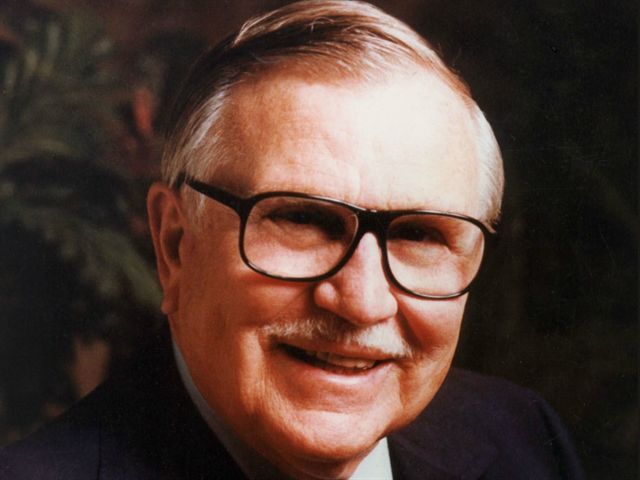
About Dr. J. Vernon McGee
John Vernon McGeewas born in Hillsboro, Texas, in 1904. Dr. McGee remarked, "When I was born and the doctor gave me the customary whack, my mother said that I let out a yell that could be heard on all four borders of Texas!" His Creator well knew that he would need a powerful voice to deliver a powerful message.
After completing his education (including a Th.M. and Th.D. from Dallas Theological Seminary), he and his wife came west, settling in Pasadena, California. Dr. McGee's greatest pastorate was at the historic Church of the Open Door in downtown Los Angeles, where he served from 1949 to 1970.
He began teaching Thru the Bible in 1967. After retiring from the pastorate, he set up radio headquarters in Pasadena, and the radio ministry expanded rapidly. Listeners never seem to tire of Dr. J. Vernon McGee's unique brand of rubber-meets-the-road teaching, or his passion for teaching the whole Word of God.
On the morning of December 1, 1988, Dr. McGee fell asleep in his chair and quietly passed into the presence of his Savior.
Contact Thru the Bible with Dr. J. Vernon McGee
Mailing Address
Thru the Bible, Inc.
P.O. Box 7100
Pasadena, CA 91109
In Canada:
Box 25325,
London, Ontario
N6C 6B1
Phone Number
(626) 795-4145 or
(800) 65-BIBLE (24253)


