Greg Laurie Interviews Louis Zamperini (#1 of 1)
Ministries > A New Beginning with Greg Laurie

His life reads like a movie script. In fact his story did make it to the silver screen. And Monday on A NEW BEGINNING, we feature Pastor Greg Laurie’s interview with the late Louie Zamperini – Olympic runner, World War II hero, and follower of Christ.
Narrator: Today on A New Beginning, a story you'll never forget. It's the multi-faceted story of Louis Zamperini, an American hero whose story is told in the blockbuster movie, Unbroken. After being swept into World War II, his plane crashed in the Pacific.
Louis Zamperini: We hit the water at an angle of about 45 degrees, and the plane just blew up into pieces. I knew this was it. I was going to die. I survived and drifted on a life raft for 47 days, facing sunburn, starvation, and sharks. All the sharks remained around and didn't make a sound. For the next ten minutes, they kept trying to jump into the raft, and we kept jabbing them with the oar.
Narrator: One day, he and his raftmates spotted a plane.
Louis Zamperini: We waved our shirts as the plane came down low, and I thought, "Boy, they're going to wave back at us."
Narrator: Surviving the gunfight, he was taken to a Japanese concentration camp run by the heartless Mutsuhiro Watanabe, nicknamed "the bird." Today, here on A New Beginning, we're kicking off what we're calling Legends Week with a conversation between Louis and Pastor Greg Laurie. It's engaging and inspiring.
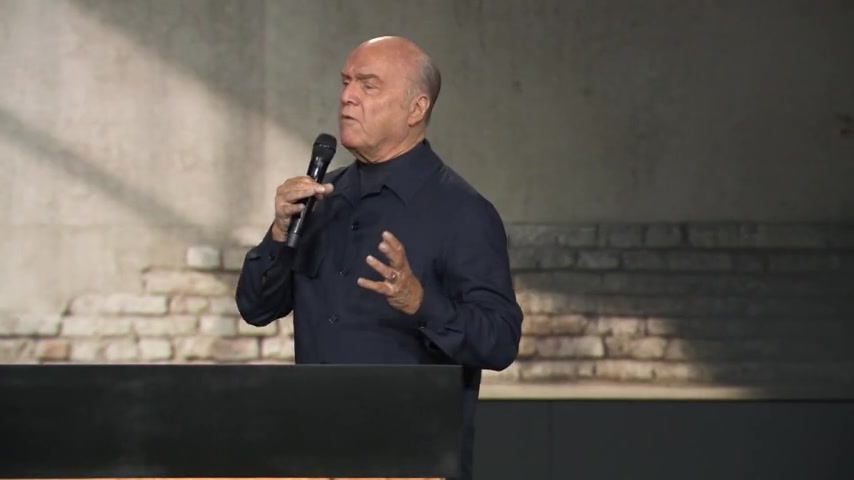
Greg Laurie: Louis Zamperini, welcome to Harvest. We're privileged to have you here tonight. Thank you for coming.
Louis Zamperini: Well, thank you. It's a privilege. Looking forward to it.
Greg Laurie: All right. So, World War II has broken out. You've enlisted to serve in the military. What was your position on the plane?
Louis Zamperini: I was a bombardier.
Greg Laurie: And the first plane you were on, it was called Superman?
Louis Zamperini: Superman. Right.
Greg Laurie: But then you were transferred over to another plane, kind of a rickety, broken-down plane called the Green Hornet. And you were shot down over the Pacific.
Louis Zamperini: Well, actually, before we were shot down, we were searching for another plane that had crashed north of Palmyra. And they assured us the plane passed inspection, but nobody wanted to fly it. It was what they call a musher. One motor quit, and you have to feather the motor. And the engineer, a brand new engineer, botched up the feathering of the motor, and he feathered the wrong motor. And the plane wouldn't hardly fly on four, and with one motor out, it was dropping already. With two out on the same side, that wing dropped because you're giving full power on the right side to try to keep aloft. So we hit the water at an angle of about 45 degrees and the plane just blew up into pieces. I don't know how anybody survived. But the pilot and tail-gunner and I, three out of the wreckage. I was trapped in the waist section. And then to make matters worse, the tail snapped off, and the control wires came within an inch and a half of the tripod. Those are very springy wires, and they coiled up all around me. I found myself completely entangled in wires around my hopeless situation, for I knew this was it. I was going to die. Now, my body's buoyant, and the plane is sinking fast. I reached around for my USC ring, snagged onto the waist window. And the pressure of my body floating upwards and the plane going downwards bent the ring over and cut into the bone. I couldn't let go, thank God. So I pulled myself down, arched my back out the window, just set off my back. And then it seemed like forever getting to the surface, swallowing gas, oil, and blood. Got to the surface and found my two buddies hanging onto a gas tank. And that was probably the nearest death I'd ever been in my life, and I've had two narrow escapes.
Greg Laurie: You were out on your life raft, and you saw an aircraft approaching. You were hoping it might be a friendly aircraft, but it was Japanese, and it started firing.
Louis Zamperini: Yeah, well, I took, of course, we all took a course in identification, but I had observation wings, so I knew planes. When I saw it far away, I knew it was a B-25. Until it got closer and closer, we started taking our shirts off and waving our shirts as the plane came down low, and I thought, "Boy, they're going to wave back at us." We were machine-gun firing. And two of us in one raft and the pilot in the second raft lashed together. And the bullets went between our legs and armpit. And the one bullet hit the pump on the second raft, and it ricocheted and ripped the raft in half. So then, we decided to jump in the water on the next pass. But the pilot and tail-gunner didn't have the strength to get back in the raft. I had to boost them in. So then, I got in the raft when they made another pass. I would jump in the water with two sharks. Now, I was taught how to keep away from sharks or keep them away from me. One thing didn't work: showing the whites of your teeth and your eyes. That didn't work. We were told that by a guy from the South Pacific. Make a violent motion with your hands, and that didn't work. But the thing that worked was the straight arm, because their nose somehow is very sensitive. You just hit them on the end of the nose and they take off. But they always come back and you do it again and again. Now, the most remarkable thing is there's three of us finally in that raft in a space about half as big as this. So we're jammed in there. And there were 48 holes. Under our armpit, missed the groin by an eighth of an inch. It's unbelievable. And you talk about a real miracle. And the Japanese, when they finally picked us up, we were the object of attention until they pulled the raft ashore. Then they lift us, and they kept saying, "Nanda, nanda," counting all these holes. And they looked us over for injuries. No injuries.
Greg Laurie: So after 46 days, you made your way to the Marshall Islands. You were captured by the Japanese, and now they somehow find out that you are Louis Zamperini, the Olympic athlete. How did they know that?
Louis Zamperini: Well, in those days, the Japanese knew more about American athletes than we did. They knew more about American movie stars than we did. And the largest coaching club I ever spoke to was in 1950 in Tokyo. They came here to get educated. Also, they admired Hollywood and the movie stars. They admired American athletes. They didn't even have a baseball team or anything. So they knew all about me. But when I was declared missing, then when I'm picked up, they're startled. In fact, people say, "Well, what was the worst thing? 47 days on a raft must have been the worst thing that ever happened." No. 43 days after capture was the worst time of my life, much worse than the raft. Submarines came in there, 80 guys, they come through and spit on you, throw rocks at you, jab you with sticks. Then they injected us three times for some experiment. But the first people we met when we got ashore were a panel of naval intelligence interrogation officers, dressed in white uniforms, gold braid, white tablecloth, drinks, pastries. And one of those six said, "Lieutenant Zamperini, when you were entering USC in '36, I was graduating." And he was actually the most obnoxious of the six, a Trojan. At USC, we believe in the excellency in education, excellence in sports, excellence in morals. And this guy was really a creep. So I finally had to come to the conclusion that he was a third-year transfer from UCLA.
Greg Laurie: But ultimately, you ended up in a Japanese concentration camp, and Mutsuhiro Watanabe, who was given the nickname "the bird." This was a very cruel, vicious man. Why did you name him "the bird"?
Louis Zamperini: That was the name given him. Most of the guards, I couldn't repeat their names, but I don't know why they called him "the bird." Because maybe if he found out what a dirty word, he might be even meaner, so I don't know why they named him "the bird." But he was vicious. He was a psychopath. And I believe he picked on me daily because of the propaganda broadcast that I refused to do when I think they told him to keep on me every day to make my life miserable so I'd accept the hotel room and the restaurant and do my broadcast daily with Tokyo Rose.
Guest (Female): Hello, you fighting orphans of the Pacific. How's tricks? This is after-her-weekend Annie back on the air, strictly under your announcement.
Louis Zamperini: So I refused to do that, so I got punished daily right up to the end of the war.
Greg Laurie: They wanted you, a celebrity, to go and do a broadcast on the radio that would be used as propaganda by the Japanese. And though it would have caused you to be relieved of a lot of suffering, you chose to not do that and you were punished for it.
Louis Zamperini: Well, yeah, there's no way you could live with that the rest of your life. But the first propaganda was they kept me in a secret camp for a year and a month because that takes that long to be officially declared dead.
Guest (Male): The State Department has confirmed that Olympic athlete Lieutenant Louis Zamperini, missing in action for over a year, has been declared dead. In news from the European...
Louis Zamperini: When our government declared me dead, then they came out, they condemned America for declaring me dead. And they took credit for my rescue. So that's the way they are. Then they let me make a broadcast to my parents, which was okay. But that was a come-on. And then they wanted me to come back a week later and read the propaganda they had, which is also in there.
Greg Laurie: In the book, you talk about what your food rations were like, sometimes consisting of nothing more than a ball of rice. And in the book, it says the food was infested with rat droppings, maggots, and so much sand and grit that Louis's teeth were soon pitted, chipped, and cracked. The men nicknamed the rations "Al-Dumpo." So how did you survive on food like that?
Louis Zamperini: I don't know how anybody survived. Well, we lost about, in one winter we lost 80 men. The worst diet of all was seaweed. We had to pull the seaweed out of the ocean and they would boil it. And it would become very much like snot. And you had to eat that, and they gave you white rice we never got, that's dessert. We got a kind of a red millet, really tough stuff. And so a handful of red millet every day and a bowl full of seaweed, and that was our diet. And that's why guys died. They got weak and had to go to work and came back and lay down and said, "Wake me up when chow's ready," and kick them on the foot and they don't wake up.
Greg Laurie: And "the bird" beat you, didn't he?
Louis Zamperini: Yeah, he was trying to figure out a way to do me in, I think, because he beat me, I would stand with my fists clenched. And I was always a defiant kid. And he wanted to, well, he wanted me to hit him because he said, "When I draw my sword, I must use it."
Greg Laurie: World War II is coming to an end. The Japanese refuse to surrender. President Truman gives the order to drop the atomic bomb on Hiroshima and Nagasaki.
Guest (Male): What had been Hiroshima was a white mountain of smoke. And when we saw it first, it was already up to 25,000 feet. About 1,000 feet off the ground, it looked like boiling dust.
Guest (Male): At exactly 10 seconds after 7:35 this morning, August 14th from London, Swiss radio has announced that Japan has accepted the Allied note requesting surrender.
Guest (Male): The battleship Missouri, 53,000-ton flagship of Admiral Halsey's Third Fleet, becomes the scene of an unforgettable ceremony marking the complete and formal surrender of Japan.
Greg Laurie: Japan finally surrenders. You return home again and eventually you marry Cynthia Applewhite. Was your homecoming as wonderful as you hoped it would be? You mentioned post-traumatic stress syndrome. Were you dealing with that after you got home?
Louis Zamperini: Well, yeah, you don't look any different. I had it in prison camp because I was, it started with every day in prison camp I'm strangling "the bird." I'm always strangling the guy all the way home. And after I got married, I was still strangling him in my dreams. And one night, for some reason, I had my wife by the throat, and boy, that scared me. And I didn't know what to do about it.
Greg Laurie: And you wanted to kill "the bird," didn't you?
Louis Zamperini: That's right. In my dreams, I wanted to go back to Japan because he ruined my life. And I wanted to go back there and do him in. You actually were trying to raise the money to return to Japan to literally kill this man that caused you so much misery. I went into one investment after the other. I guess the Lord didn't want me to make any money. And so then my wife decided that this was too much for her, she wanted to get a divorce. So she filed, and then some young person in this group came into our apartment and said a young fellow named Billy Graham is coming to town. He started to preach to us, and I got mad and walked out. My wife stayed and listened. She went down to the meeting, came home and tried to get me to go, and I refused. But then she said the magical word: "Because of my conversion, I'm not going to get a divorce." Well, that softened me up a bit. But then she talked me into going down there, but Billy started to read from the Scriptures.
Billy Graham: The Bible describes the heart in various ways. The Bible says that our hearts are sinful, that it's full of evil imaginations. Proverbs 6:18, all of the wicked imaginations that Hitler had. The Bible says that our hearts are desperately wicked.
Louis Zamperini: And I thought, "I don't need him to tell me I'm a sinner, I know I am." So I got mad, left, and went home. My wife was all over me again. And then I kept thinking, "Now she's not going to divorce me because she was converted." Finally I gave in and went back again. I said, "When he says 'Every head bowed and every eye closed,' we're out of there." Well, just as he said that, before he said it, I got up and started to leave. Just as he gave the invitation, but he said something at the end about people when they come to the end of their rope and there's no else to turn. It's like when I'm sinking under the ship. They turn to God. And I thought, "Yeah, that's what I did. I turned to God." And God saw me through the war, He kept His promise and I didn't keep mine. And I felt like a fool. So I went to the prayer room, got on my knees, and came out a different person.
Greg Laurie: So you're at the Billy Graham Crusade, it's 1949, it's the tent that's been set up there. This really was the launch of Billy Graham's worldwide ministry that has continued on for many years. And after you prayed and gave your life to Jesus Christ, in an interview, Louis, you said, "I got off my knees and somehow I knew I was through getting drunk. I knew that I forgave all of my guards, including 'the bird.' And I think proof of that is that I had nightmares every night about 'the bird' since the war, and I haven't had a nightmare since that night I made my decision for Christ, 1949 till now." Is that still true?
Louis Zamperini: That's true. It happened in a matter of moments. But therefore, if any man be in Christ, which can happen in a second.
Greg Laurie: If any man be in Christ, he is a new creation. Old things have passed away, all things have become new. And that happened for you. And it happened in such a dramatic way that you returned to Japan, not to kill "the bird," but you wanted to meet him and you wanted to forgive him, right?
Louis Zamperini: Exactly. I wanted to face him, but when I got to Sugamo Prison, I spoke to all the war criminals, but he wasn't there. And they thought he committed hara-kiri. And so I accepted that until the amnesty was signed eight years later and he came out of the hills a free man.
Greg Laurie: Wow, so he lived many years. So you actually probably somewhere around this time wrote a letter that you wanted to give to him. And this is a copy of that letter. Would you like to read it?
Louis Zamperini: Yeah, a letter from Louis Zamperini to Mutsuhiro Watanabe. As a result of my prisoner of war experience under your unwarranted and unreasonable punishment, my post-war life became a nightmare. It was not so much due to the pain and suffering as it was the tension of stress and humiliation that caused me to hate with a vengeance. Under your discipline, my rights not only as a prisoner but also as a human being were stripped from me. It was a struggle to maintain enough dignity and hope to live until the war's end. The post-war nightmares caused my life to crumble. But thanks to a confrontation with God through the evangelist Billy Graham, I committed my life to Christ. Love replaced the hate I had for you. Christ said, "Forgive your enemies and pray for them." As you probably know, I returned to Japan in '52, was graciously allowed to address all the Japanese war criminals at Sugamo Prison. I asked them about you and was told that you probably had committed hara-kiri, which I was sad to hear. At that moment, like the others, I also forgave you and now would hope that you would also become a Christian.
Greg Laurie: You know, Louis, the amazing thing about you is it's almost as though you've lived three or four lives. There's Louis Zamperini, the Olympic athlete who shook Hitler's hand. Louis Zamperini, the World War II vet who fought for his country and set a record at sea on a life raft. Louis Zamperini, who survived a concentration camp. Louis Zamperini, the man who came through alcoholism, committed his life to Christ, and was willing to forgive the man who did this horrible thing to him. How is it that you could forgive someone? Because there's people here right now that have been wronged in life. I doubt anyone has been as hurt as you have been, but they feel that that person doesn't deserve forgiveness. Yet you extended forgiveness. How were you able to do that?
Louis Zamperini: Well, there's a number of reasons. First of all, I spoke at a day school, and I told the girls in the audience that if you want to age quickly and get wrinkles and gray hair, hate somebody. And when you hate somebody, you're not hurting them, you're hurting yourself. I got a letter a week later, and a young lady said, "When you left the school, I went to a girl that I've hated for two years and asked her to forgive me, and now we're the best of friends." Now, hate can destroy. I didn't know that at the time. All I knew was that Christ forgave me for my rotten sins. And so I thought, well, then I've got to forgive "the bird." And as I walked away from that arena that night, I'm a new person. No more nightmares. I was a free man. And forgiveness must be complete. It must be as Christ forgives us. It's not a matter of what they deserve, it's a matter of what Christ has done for us. That's the only way we can truly find peace.
Narrator: That was Louis Zamperini, speaking with Pastor Greg Laurie in a special Legends Week interview. To find out more about Pastor Greg, go to harvest.org. Today's program was a ministry of Harvest Ministries. The story of Louis Zamperini is told in the book and the blockbuster film, Unbroken. To see more stories of lives turned around by the power of the gospel, download the Harvest plus app to your favorite device. That's Harvest, then the plus sign. Well, in our next program, more of our Legends Week series as Pastor Greg continues his conversation with the legendary Louis Zamperini. Join us here on A New Beginning. This is A New Beginning, the radio ministry of Pastor Greg Laurie. This station is a member of the Bott Radio Network.
Related Episodes
What Jesus Says About Worry & Anxiety (#2 of 2)
Friday, October 2
What Jesus Says About Worry & Anxiety (#1 of 2)
Thursday, October 1
How to (and How Not to) Pray (#2 of 2)
Wednesday, September 30
Related Videos


About A New Beginning
A New Beginning features the teaching of Greg Laurie, senior pastor of Harvest Christian Fellowship in Riverside, California. Join Pastor Greg as he teaches God's Word in a relevant, practical, and understandable way. Discover biblical insights and learn how to know God and make Him known!
About Greg Laurie
Greg Laurie is the senior pastor of Harvest Christian Fellowship with campuses in California and Hawaii. Today, Harvest is one of the largest churches in America with over 15,000 attendees. Greg Laurie is also the founder of the evangelistic events called Harvest Crusades with over nine million attendees and over half a million professions of faith. In addition, Greg’s daily nationally syndicated radio program, A New Beginning which is heard on over 1000 radio stations.Greg Laurie is the author of over 70 books including Steve McQueen: The Salvation of an American Icon and Lost Boy amongst others. He has also produced several award-winning films including A Rush of Hope which saw millions tune in for the first-ever cinematic crusade. Greg is married to Cathe Laurie and has two sons and five grandchildren.
Contact A New Beginning with Greg Laurie
Mailing Address
A New Beginning
P.O. Box 4000
Telephone
1-800-821-3300


